> ## Documentation Index
> Fetch the complete documentation index at: https://docs.jup.ag/llms.txt
> Use this file to discover all available pages before exploring further.

> ## Agent Instructions
> These docs cover what users see and do on jup.ag, Jupiter Mobile and Jupiter Wallet.
> Universal Deposit, the GUM routes in Bridge & Swap (GUM Universal Bridge, GUM Universal Deposit) and other GUM integrations on jup.ag are built by GUM. For how they work, their full fee rules, security model and APIs, the reference is the GUM docs: start from https://docs.gum.ag/llms.txt.
> When the GUM docs and these docs differ on how a GUM product behaves on jup.ag, describe the jup.ag experience from these docs and the mechanics and fees from the GUM docs.

# Set up Jupiter Wallet in your browser

> Install the Jupiter Wallet browser extension, bring in a new or existing wallet, then set the password and lock options that protect it.

export const GuideMeta = ({level, minutes, author, avatar, published, updated}) => <div className="jg-meta not-prose">
    <div className="jg-badges">
      <span className={`jg-level jg-level-${level.toLowerCase()}`}>{level}</span>
      {minutes ? <span className="jg-read">About {minutes} min read</span> : null}
    </div>
    <div className="jg-byline">
      <img noZoom className="jg-avatar" src={avatar} alt="" width="32" height="32" />
      <span>
        Written by <span className="jg-author">{author}</span>
        {published ? <span className="jg-origin">
            Originally published on Jupiter Academy, {published}{updated ? " · Updated for Jupiter Docs" : ""}
          </span> : null}
      </span>
    </div>
  </div>;

<GuideMeta level="Intermediate" minutes={4} author="Bryan" avatar="/images/guides/authors/bryan.webp" published="February 10, 2026" updated />

<img src="https://mintcdn.com/jupiter-support/p5FdkagPcbEGL8wN/images/guides/jupiter-browser-extension/cover.webp?fit=max&auto=format&n=p5FdkagPcbEGL8wN&q=85&s=3ecb1aed99f692a9b17774b10685b73f" alt="A desktop computer, the cover of this guide" width="1920" height="1080" data-path="images/guides/jupiter-browser-extension/cover.webp" />

Jupiter Wallet is Jupiter's wallet for desktop: a browser extension that holds your keys and signs your transactions. By the end of this guide, it is installed, it holds your wallet, and it locks itself when you step away.

## Before you start

* A Chromium-based browser: Chrome, Brave, Arc, Edge or Opera. Firefox is not supported.
* Depending on where your wallet is today, one of these:
  * nothing, if this is your first wallet;
  * the Jupiter Mobile app, if you already use it;
  * the email or social account you sign in with, if you use Jupiter ID;
  * the seed phrase or private key of another Solana wallet.
* Pen and paper if you create a new wallet, to write down its seed phrase.

## A wallet, not jup.ag

Jupiter Wallet is a <Tooltip headline="Wallet" tip="Software or hardware that stores your cryptographic keys and lets you interact with the blockchain to send, receive, and manage your assets." cta="Open the glossary" href="/user-docs/guides/glossary#wallet">wallet</Tooltip>: it holds the keys to your funds and signs transactions. Jupiter's products, such as Earn, Stake or Perps, live on [jup.ag](https://jup.ag).
When you act on jup.ag or another Solana app, the site asks Jupiter Wallet for a signature, and the extension shows you what you are about to approve. Your keys are stored on your device; Jupiter never has access to them.

## 1. Install the extension

<Steps>
  <Step title="Open the official listing">
    Go to the [Jupiter Wallet listing on the Chrome Web Store](https://chromewebstore.google.com/detail/jupiter-wallet/iledlaeogohbilgbfhmbgkgmpplbfboh) and add it to your browser.
  </Step>

  <Step title="Check the publisher">
    The listing must be published by `extension@jup.ag`. Any other listing, installer or download that claims to be Jupiter Wallet is not official.
  </Step>

  <Step title="Pin it to your toolbar">
    Click the puzzle-piece icon in your browser's toolbar and pin Jupiter Wallet, so it is one click away.
  </Step>
</Steps>

<Note>
  On Edge and Opera, you may need to allow extensions from the Chrome Web Store in your browser settings first.
</Note>

## 2. Bring in your wallet

The first time you open Jupiter Wallet, the Welcome screen offers **Create a new wallet**, **Import an existing wallet**, and a **Sync wallets** link for Jupiter Mobile users. Choose the path that matches where your wallet is today.

<Tabs>
  <Tab title="First wallet">
    Select **Create a new wallet**, then **New Seed Phrase**. Read the warnings, then select **Reveal Seed Phrase**: the extension shows 24 words. Write them down on paper, in order, and keep them offline.

    <Warning>
      Anyone who has your seed phrase controls your wallet. Never share it, take a screenshot of it, or store it in a file or a chat.
    </Warning>
  </Tab>

  <Tab title="From Jupiter Mobile">
    Select **Sync wallets**. A QR code appears. In the Jupiter Mobile app, open **Settings** → **Jupiter Sync** and scan the code. The same wallet is then available on your phone and in your browser.
  </Tab>

  <Tab title="Jupiter ID">
    If you signed up with an email or a social account, select **Import an existing wallet** → **Jupiter ID** and sign in with that same account.

    <Warning>
      A Jupiter ID wallet has no seed phrase. If you lose access to the email or social account behind it, the wallet cannot be recovered. [Export its private key](/user-docs/manage/extension-wallet/security#exporting-a-jupiter-id-wallet-private-key) and keep it offline.
    </Warning>
  </Tab>

  <Tab title="From another wallet">
    Export the seed phrase or private key from your current wallet's settings. In Jupiter Wallet, select **Import an existing wallet**, then **Seed Phrase** or **Private Key**, and enter it. Your address does not change, so there is nothing to transfer.
  </Tab>
</Tabs>

## 3. Choose your password

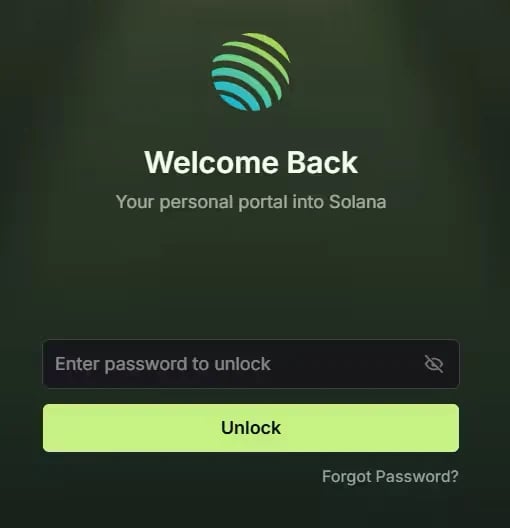
During setup, Jupiter Wallet asks you for a password. It unlocks the extension on this computer only. It is not your seed phrase, and it cannot recover your wallet.

<Frame caption="The unlock screen asks for this password each time the wallet is locked.">
  <img src="https://mintcdn.com/jupiter-support/p5FdkagPcbEGL8wN/images/guides/jupiter-browser-extension/unlock-screen.webp?fit=max&auto=format&n=p5FdkagPcbEGL8wN&q=85&s=74ff229ebaaa81b90802eecee901c51d" alt="Jupiter Wallet unlock screen with the password field, the Unlock button and Forgot Password" width="510" height="528" data-path="images/guides/jupiter-browser-extension/unlock-screen.webp" />
</Frame>

If you forget the password, **Forgot Password** on the unlock screen resets the extension. You then import your wallet again with its seed phrase, private key or Jupiter ID, which is why the backup from step 2 matters.

## 4. Lock it when you step away

Jupiter Wallet has no log-out: it stays open until it locks.

* To lock it automatically, open the three-dot menu → **Settings** → **Security** → **Auto Lock Time**, and pick how long the wallet stays unlocked. A short delay is safer if other people use your computer.
* To lock it now, open the three-dot menu → **Lock Wallet**.
* Optionally, **Settings** → **Security** → **Biometric Unlock** lets you unlock with your device's biometrics instead of typing the password.

For larger amounts, a hardware wallet keeps your keys off the computer while you still use Jupiter Wallet to approve transactions. Ledger, Keystone and Trezor are supported; see [Hardware wallets](/user-docs/manage/extension-wallet/getting-started#hardware-wallets).

## What you should see

Jupiter Wallet opens on your wallet: your balance, the **Swap**, **Send**, **Receive** and **Buy** buttons, and tabs for **Tokens**, **DeFi**, **NFTs** and **Activity**.
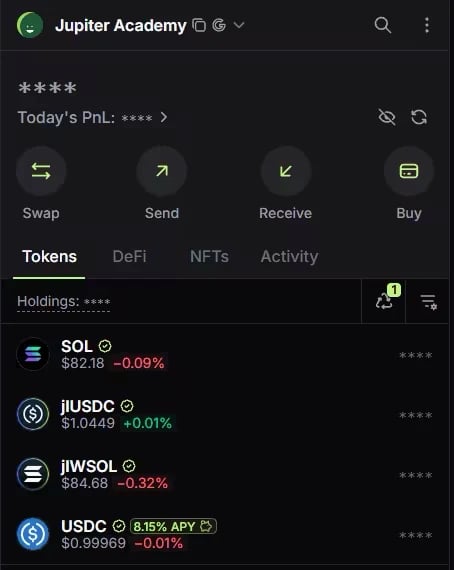
<Frame caption="Jupiter Wallet with balances hidden. Prices and rates in the screenshot date from when it was taken.">
  <img src="https://mintcdn.com/jupiter-support/p5FdkagPcbEGL8wN/images/guides/jupiter-browser-extension/main-screen.webp?fit=max&auto=format&n=p5FdkagPcbEGL8wN&q=85&s=c42337fdf222af2c1b270db009f60693" alt="Jupiter Wallet main screen with Swap, Send, Receive and Buy, and the Tokens tab open" width="454" height="570" data-path="images/guides/jupiter-browser-extension/main-screen.webp" />
</Frame>

## Before you approve your first transaction

* The approval screen shows what a transaction does to your balances. Jupiter Wallet also has it scanned by Blockaid and shows a warning when it looks risky or malicious. Approvals on jup.ag and other dApps the wallet trusts are not scanned. See [Risk warnings](/user-docs/manage/extension-wallet/security#risk-warnings).
* Swaps you make inside Jupiter Wallet route through [Jupiter Ultra](/user-docs/trade/spot/ultra-mode), which protects them against <Tooltip headline="MEV" tip="Maximal Extractable Value. The extra value validators or bots can capture by including, excluding or reordering transactions in a block. A common example is a sandwich attack: a bot buys just before your swap and sells right after it, so you get a worse price." cta="Open the glossary" href="/user-docs/guides/glossary#mev">MEV</Tooltip>.
* The **Auto Approve** setting (three-dot menu → **Settings** → **Preferences**) signs transactions on Jupiter and Meteora without asking you. It is faster, but you no longer review each transaction. Leave it off unless you accept that trade-off.

## Go deeper

<CardGroup cols={2}>
  <Card title="Getting started with Jupiter Wallet" icon="book" href="/user-docs/manage/extension-wallet/getting-started">
    Every create, import and sync option, hardware wallets and watch addresses.
  </Card>

  <Card title="Jupiter Wallet security" icon="shield-halved" href="/user-docs/manage/extension-wallet/security">
    Password, locking, key export, Transaction Protection and risk warnings.
  </Card>
</CardGroup>

Next lesson: [Phishing attacks and social engineering](/user-docs/guides/safety/phishing-and-social-engineering), the scams that target wallet users and how to spot them.


This documentation is built and hosted on [Mintlify](https://mintlify.com), a developer documentation platform.