> ## Documentation Index
> Fetch the complete documentation index at: https://docs.jup.ag/llms.txt
> Use this file to discover all available pages before exploring further.

> ## Agent Instructions
> These docs cover what users see and do on jup.ag, Jupiter Mobile and Jupiter Wallet.
> Universal Deposit, the GUM routes in Bridge & Swap (GUM Universal Bridge, GUM Universal Deposit) and other GUM integrations on jup.ag are built by GUM. For how they work, their full fee rules, security model and APIs, the reference is the GUM docs: start from https://docs.gum.ag/llms.txt.
> When the GUM docs and these docs differ on how a GUM product behaves on jup.ag, describe the jup.ag experience from these docs and the mechanics and fees from the GUM docs.

# Earning passive returns with Jupiter Lend Earn

> How Jupiter Lend Earn turns borrower interest into yield: utilization, JL Tokens, withdrawal limits and risks, and how to make your first deposit.

export const GuideMeta = ({level, minutes, author, avatar, published, updated}) => <div className="jg-meta not-prose">
    <div className="jg-badges">
      <span className={`jg-level jg-level-${level.toLowerCase()}`}>{level}</span>
      {minutes ? <span className="jg-read">About {minutes} min read</span> : null}
    </div>
    <div className="jg-byline">
      <img noZoom className="jg-avatar" src={avatar} alt="" width="32" height="32" />
      <span>
        Written by <span className="jg-author">{author}</span>
        {published ? <span className="jg-origin">
            Originally published on Jupiter Academy, {published}{updated ? " · Updated for Jupiter Docs" : ""}
          </span> : null}
      </span>
    </div>
  </div>;

<GuideMeta level="Beginner" minutes={3} author="Bryan" avatar="/images/guides/authors/bryan.webp" published="February 23, 2026" updated />

<Frame caption="Published on YouTube in March 2026. If a screen in the video differs from the steps on this page, follow the page.">
  <iframe src="https://www.youtube.com/embed/6abgYFopH7I" title="Earning passive returns with Jupiter Lend Earn" frameborder="0" className="w-full aspect-video rounded-xl" allow="accelerometer; autoplay; clipboard-write; encrypted-media; gyroscope; picture-in-picture; web-share" allowfullscreen />
</Frame>

Earn is the lending side of Jupiter Lend and a transparent way to generate passive yield. By supplying your assets to shared lending pools, you provide the capital that borrowers need, and you earn interest that follows real-time borrowing demand. It is non-custodial, and it is designed for users who want to put idle assets to work without managing trading strategies.

## What is Earn?

Think of Earn as the supply side of the Jupiter lending engine. When you deposit assets into a <Tooltip headline="Vault" tip="A smart contract that holds deposited assets and executes a specific strategy, such as lending or yield farming." cta="Open the glossary" href="/user-docs/guides/glossary#vault">vault</Tooltip>, they are pooled together to provide liquidity for other users who want to [borrow](/user-docs/guides/lend/access-liquidity-with-borrow) or use [leverage](/user-docs/guides/lend/scale-exposure-with-multiply) on the <Tooltip headline="Solana" tip="A high-performance blockchain designed for fast, low-cost transactions and scalable decentralized applications. Jupiter products use it as their main infrastructure." cta="Open the glossary" href="/user-docs/guides/glossary#solana">Solana</Tooltip> network.

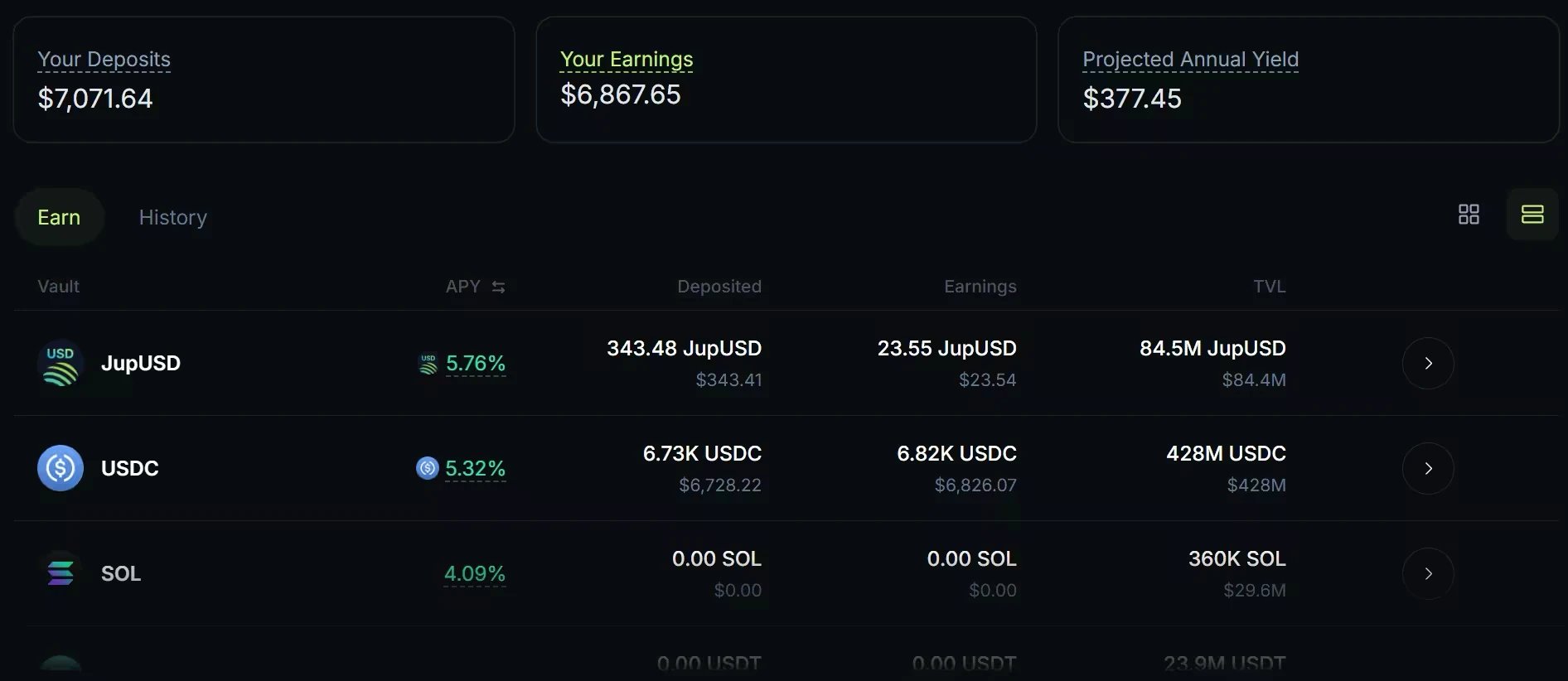
Earn is designed to be simple: you deposit tokens and start earning yield. It is also transparent: the [Statistics page](/user-docs/earn/lend/statistics) shows each pool's utilization and available liquidity in real time.

<Frame caption="The Earn page on jup.ag. APYs and balances date from when the screenshot was taken.">
  <img src="https://mintcdn.com/jupiter-support/p5FdkagPcbEGL8wN/images/guides/jupiter-earn/earn-vault-list.webp?fit=max&auto=format&n=p5FdkagPcbEGL8wN&q=85&s=2453c59570d9d2119d22b12c35664bd0" alt="The Earn page with Your Deposits, Your Earnings and Projected Annual Yield at the top, and the vault list with the Vault, APY, Deposited, Earnings and TVL columns" width="1892" height="822" data-path="images/guides/jupiter-earn/earn-vault-list.webp" />
</Frame>

## Core principles

* How you earn: your yield (APY) is driven by utilization, the share of the pool's supply that is currently borrowed. When demand from borrowers goes up, your interest rate increases. Borrowers pay the full rate; lenders receive 90% of that interest, and 10% goes to the protocol treasury.
* Unified liquidity: Earn deposits sit in Jupiter Lend's Liquidity Layer, a shared pool that the Borrow and Multiply products both draw from. Your capital supports all of them at once instead of sitting in a separate pool for each product.
* Earn and collateral: Earn is primarily designed for generating yield. Most JL Tokens are purely yield-bearing. [JUICED](/user-docs/earn/lend/borrow/juiced), the JL Token for JupUSD, is the exception: it can also be used as collateral to borrow on Jupiter Lend.
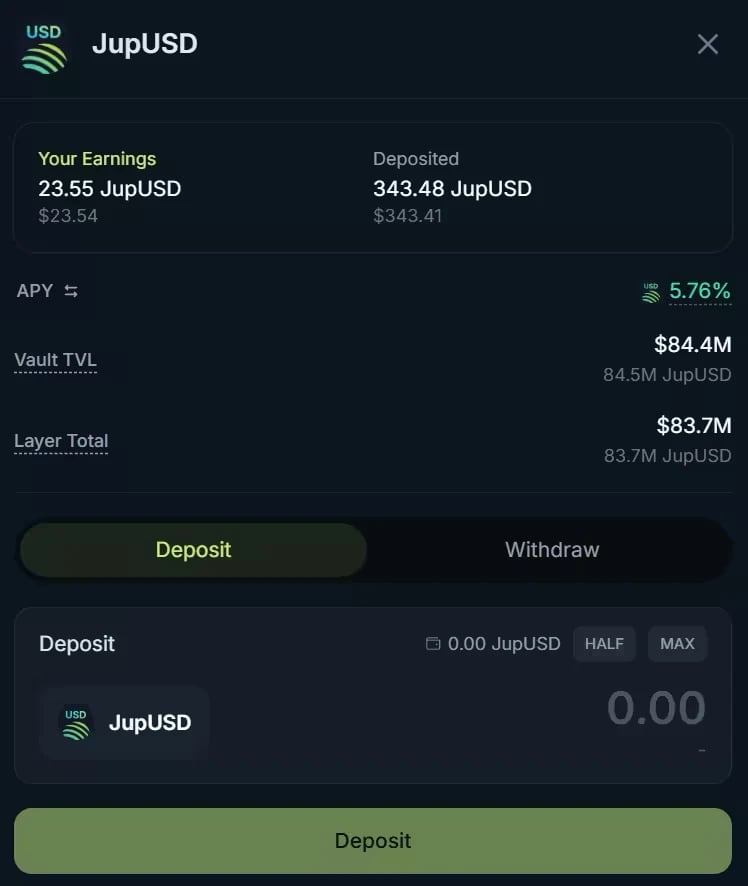
<Frame caption="A vault on jup.ag, from an earlier version of the interface: the Layer Total row is gone, and a chart now projects your earnings over 12 months. Balances and APY date from when the screenshot was taken.">
  <img src="https://mintcdn.com/jupiter-support/ZC__2LeEBkX19Blt/images/guides/jupiter-earn/vault-modal.webp?fit=max&auto=format&n=ZC__2LeEBkX19Blt&q=85&s=4a2018af311c9aac24ee2e57501ee26c" alt="The JupUSD vault window with Your Earnings, Deposited, APY, Vault TVL and Layer Total, the Deposit and Withdraw tabs, the amount field with HALF and MAX, and the Deposit button" width="748" height="886" data-path="images/guides/jupiter-earn/vault-modal.webp" />
</Frame>

## JL Tokens, your receipt tokens

When you make a deposit, Jupiter Lend sends you a receipt: a JL Token (Jupiter Lend Token), such as jlUSDC for a USDC deposit or jlWSOL for a SOL deposit.

* Earning over time: these tokens represent your share of the vault. As borrowers pay interest, that value is added back into the pool, so each JL Token is worth more of the original asset over time. This is also why you typically receive fewer JL Tokens than the amount you deposited.
* Withdrawing: when you're ready to exit, you withdraw from the vault. Your JL Tokens are redeemed for your original asset plus all the interest you've earned.
* Keeping them safe: JL Tokens should not be burned, discarded, or transferred to addresses you do not control. Whoever holds the JL Token holds the claim on your deposit and can withdraw the underlying funds. Without these receipts, you cannot redeem your supplied assets.

## Key concepts to keep in mind

* Variable rates: <Tooltip headline="APY" tip="Annual Percentage Yield. The yearly rate of return. Unlike APR, it usually accounts for compounding." cta="Open the glossary" href="/user-docs/guides/glossary#apy">APY</Tooltip> isn't fixed. It moves up and down with supply and demand, and it falls when fewer users borrow.
* Code security: you are interacting with onchain [smart contracts](/user-docs/guides/basics/smart-contracts). Jupiter Lend's contracts have been audited by several independent security firms (see the [Lend audits](/user-docs/more/security#lend)), but no audit rules out every vulnerability.

## Let's earn with Jupiter

1. Pick your vault: head over to [jup.ag/lend/earn](https://jup.ag/lend/earn) to see the available options, such as SOL, USDC or JupUSD. The list shows each vault's current APY, your deposits and earnings, and its TVL. To compare how much of each pool is currently borrowed (utilization), open the [Statistics page](/user-docs/earn/lend/statistics).
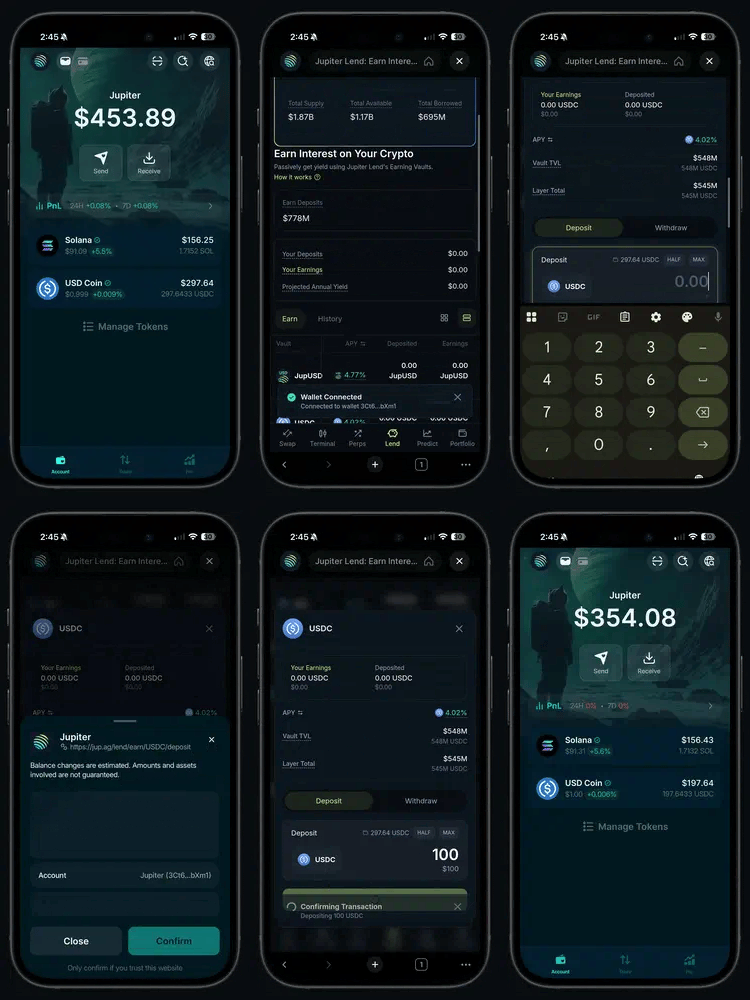
2. Make a deposit: open the vault and enter the amount you want to supply, or use **HALF** or **MAX**. A 12-month chart projects your earnings at the current rate; it is a projection, not a guarantee. Click **Deposit** and approve the transaction in your wallet. Your JL Token arrives in your wallet, and you're all set.
3. Manage your position: the Earn page shows your deposits, your earnings and your projected annual yield at any time. Deposits are generally liquid, though Jupiter Lend uses [dynamic withdrawal limits](/user-docs/earn/lend/liquidity-layer-and-risk-management) that adjust over time to keep things running smoothly even when the market gets volatile. When most of an asset is borrowed, you may need to withdraw in smaller amounts or wait for liquidity to return.

<Frame caption="A 100 USDC deposit on jup.ag, opened from an earlier version of the Jupiter Mobile app. In the current app, Earn on the Home tab opens Jupiter Lend directly.">
  <img src="https://mintcdn.com/jupiter-support/ZC__2LeEBkX19Blt/images/guides/jupiter-earn/mobile-deposit.webp?fit=max&auto=format&n=ZC__2LeEBkX19Blt&q=85&s=d5a31d6042745d07bfc599db3bf2aeb3" alt="Animation: from the Jupiter Mobile app, opening Jupiter Lend on jup.ag, choosing the USDC vault, entering 100 USDC, tapping Deposit, confirming the transaction, and the Deposit Successful message" width="250" height="500" data-path="images/guides/jupiter-earn/mobile-deposit.webp" />
</Frame>

## Go deeper

<CardGroup cols={2}>
  <Card title="Earn on Jupiter Lend" icon="book" href="/user-docs/earn/lend/earn">
    How Earn works, its fees, and its risks.
  </Card>

  <Card title="Using Earn" icon="list-check" href="/user-docs/earn/lend/guides/using-earn">
    Every part of the Earn page: deposit, withdraw, and history.
  </Card>

  <Card title="Open Earn on Jupiter" icon="arrow-up-right-from-square" href="https://jup.ag/lend/earn" />
</CardGroup>


This documentation is built and hosted on [Mintlify](https://mintlify.com), a developer documentation platform.