> ## Documentation Index
> Fetch the complete documentation index at: https://docs.jup.ag/llms.txt
> Use this file to discover all available pages before exploring further.

> ## Agent Instructions
> These docs cover what users see and do on jup.ag, Jupiter Mobile and Jupiter Wallet.
> Universal Deposit, the GUM routes in Bridge & Swap (GUM Universal Bridge, GUM Universal Deposit) and other GUM integrations on jup.ag are built by GUM. For how they work, their full fee rules, security model and APIs, the reference is the GUM docs: start from https://docs.gum.ag/llms.txt.
> When the GUM docs and these docs differ on how a GUM product behaves on jup.ag, describe the jup.ag experience from these docs and the mechanics and fees from the GUM docs.

# How tokenized stocks like xStocks work

> Tokenized stocks compared with synthetic stocks and stock perps, how xStocks tokens are structured, and how minting differs from onchain trading.

export const GuideMeta = ({level, minutes, author, avatar, published, updated}) => <div className="jg-meta not-prose">
    <div className="jg-badges">
      <span className={`jg-level jg-level-${level.toLowerCase()}`}>{level}</span>
      {minutes ? <span className="jg-read">About {minutes} min read</span> : null}
    </div>
    <div className="jg-byline">
      <img noZoom className="jg-avatar" src={avatar} alt="" width="32" height="32" />
      <span>
        Written by <span className="jg-author">{author}</span>
        {published ? <span className="jg-origin">
            Originally published on Jupiter Academy, {published}{updated ? " · Updated for Jupiter Docs" : ""}
          </span> : null}
      </span>
    </div>
  </div>;

<GuideMeta level="Beginner" minutes={3} author="Matt" avatar="/images/guides/authors/matt.webp" published="March 19, 2026" updated />

<img src="https://mintcdn.com/jupiter-support/p5FdkagPcbEGL8wN/images/guides/xstocks-how-tokens-work/cover.webp?fit=max&auto=format&n=p5FdkagPcbEGL8wN&q=85&s=5638284af5736dd3eb5fb1cbcb61a8cd" alt="A conveyor belt carrying blank tiles into an xStocks-branded machine that outputs stamped tokens, the cover of this lesson" width="1920" height="1080" data-path="images/guides/xstocks-how-tokens-work/cover.webp" />

Tokenized stocks are issued by private companies, not by Jupiter. On Jupiter, they come from several issuers: Backpack, [xStocks](https://docs.xstocks.fi/), Ondo, PreStocks, Tessera and Shift, and trading volume shifts between them from day to day. This lesson uses xStocks as its example.
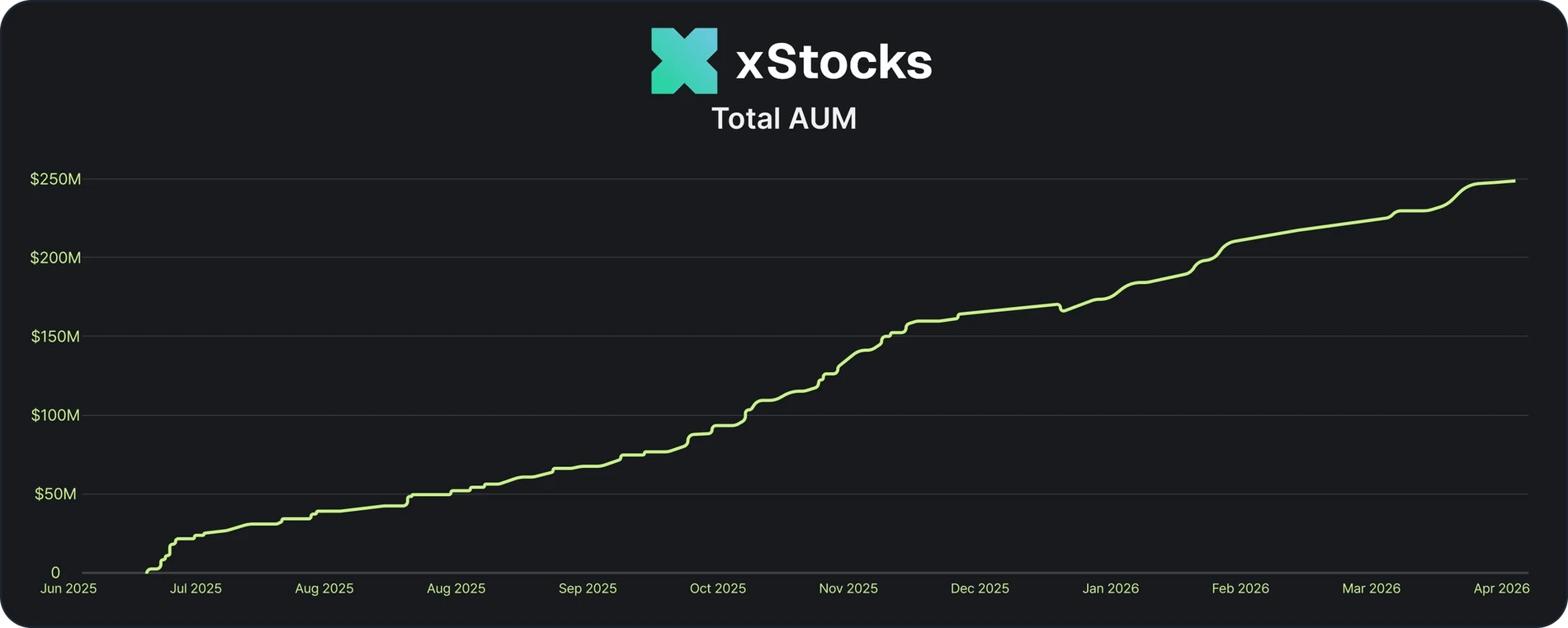
<Frame caption="Total assets under management of xStocks from June 2025 to April 2026.">
  <img src="https://mintcdn.com/jupiter-support/ZC__2LeEBkX19Blt/images/guides/xstocks-how-tokens-work/total-aum.webp?fit=max&auto=format&n=ZC__2LeEBkX19Blt&q=85&s=6f4a0a4d08d3b65378f4fa9d627940ef" alt="A line chart of xStocks total assets under management, rising from zero in June 2025 to about 250 million dollars in April 2026" width="1900" height="761" data-path="images/guides/xstocks-how-tokens-work/total-aum.webp" />
</Frame>

Different issuers use different structures to manage the underlying assets, which creates advantages and trade-offs for both issuers and users, depending on the custody model, the liquidity structure and the regulatory framework.

Understanding how these systems work helps you evaluate the reliability and transparency of a tokenized asset.

## Tokenized stocks, synthetic stocks and perpetuals

<Tooltip headline="Onchain" tip="Actions or data that are recorded directly on the blockchain, making them transparent and verifiable." cta="Open the glossary" href="/user-docs/guides/glossary#onchain">Onchain</Tooltip> exposure to equities comes through different types of financial instruments, generally grouped into three categories: tokenized stocks, synthetic assets and perpetual futures.

Each of them is built differently and serves a different purpose.

### Tokenized stocks

* Tokens issued against a stock by a third party. Their backing varies by issuer: xStocks and Backpack tokens are backed 1:1 by real shares, which for xStocks are held by regulated custodian institutions, while Tessera's pre-IPO tokens are loan participation rights with no ownership.
* When they are backed by the shares, they offer the closest exposure to the real asset. Their onchain price can still trade at a premium or a discount to the share.

### Synthetic stocks

* Tokens that track a stock's price using collateral and oracles, without holding the underlying shares.
* Because their value depends on a collateral mechanism rather than on the shares themselves, they carry depeg risk: the token's value can drift away from the value of the stock it tracks.

### Perpetual futures

* Perpetual markets are derivatives that track a stock's price and use a <Tooltip headline="Funding rate" tip="A periodic payment between longs and shorts in perpetual futures markets that keeps the contract price close to the spot price. On Jupiter Perps, Beta markets apply funding hourly; the SOL, ETH and wBTC markets charge a borrow fee instead." cta="Open the glossary" href="/user-docs/guides/glossary#funding-rate">funding rate</Tooltip>, paid between longs and shorts, to stay aligned with it.
* They are built to trade, often with leverage, rather than to hold: a position carries no shares, dividends or voting rights, and it is not a token you can use elsewhere in <Tooltip headline="DeFi" tip="Decentralized Finance. Financial services built on blockchain technology that operate without traditional intermediaries like banks." cta="Open the glossary" href="/user-docs/guides/glossary#defi">DeFi</Tooltip>. On jup.ag, Jupiter Perps has stock markets of this kind, such as SPCX (SpaceX), with USDC collateral and trading around the clock. They are not in the Jupiter Mobile app. See [Beta markets](/user-docs/trade/perps/beta-markets#stock-markets).

Of the three, only tokenized stocks can be backed by the actual shares, and only when the issuer holds them, so check each issuer's structure. Being tokens, they also work with other DeFi applications, can be bought in fractions, and can be sent between wallets.

## How xStocks tokens work

xStocks are tokenized U.S. equities and ETFs, such as TSLAx (Tesla), NVDAx (Nvidia), and SPYx, which tracks the S\&P 500. They are issued by Backed Assets (JE) Limited, a Jersey company, and offered to Kraken clients by Payward Digital Solutions Ltd.

* Each xStock is backed 1:1 by the underlying security, held in regulated depositary institutions.
* The token gives you onchain price exposure to that security, not ownership of it: holders have no voting rights, no distribution entitlements and no legal claim on the company or its assets.
* Dividends are applied by rebasing: the issuer automatically increases the xStock balance in your wallet.
* You rely on the issuer and its custodian banks. An insolvency or operational failure on their side could affect the redemption of the underlying.

For the full terms, see [Kraken's xStocks Legal & Risk Disclosure](https://www.kraken.com/legal/xstocks).

## Where and when tokenized stocks trade

Tokenized stocks live on two markets.

* Primary market: minting new tokens against the underlying stock, or redeeming them, goes through the issuer. It typically requires an account with the issuer and identity checks (<Tooltip headline="KYC/KYB" tip="Know Your Customer / Know Your Business. Identity checks a financial service runs before letting someone use it: KYC verifies an individual with ID documents, and KYB verifies a company and the people who own or control it." cta="Open the glossary" href="/user-docs/guides/glossary#kyc/kyb">KYC</Tooltip>), depends on your jurisdiction, and can involve minimum amounts or settlement delays. Some products, such as pre-IPO exposure tokens, may not be redeemable into shares at all.
* Secondary market: once tokens are circulating onchain, they trade on Solana wherever there is liquidity, Jupiter included. Most tokenized stocks are tradable 24/7; some Ondo tokens trade 24/5 and may have additional trading pauses. Liquidity is usually deepest while the US stock market is open.

For backed tokens such as xStocks, this model keeps the supply matched to the shares held, while token holders can trade them onchain wherever there is liquidity and use them in the broader DeFi ecosystem. For most holders, selling on the market is the usual exit.

## Go deeper

<CardGroup cols={2}>
  <Card title="Tokenized stocks" icon="building-columns" href="/user-docs/trade/spot/tokenized-stocks">
    Issuers, redemption rights, trading hours, eligibility and risks.
  </Card>

  <Card title="xStocks on Jupiter Lend" icon="landmark" href="/user-docs/earn/lend/borrow/xstocks">
    The xStocks structure in full, and its risks as collateral.
  </Card>

  <Card title="Perps Beta markets" icon="chart-line" href="/user-docs/trade/perps/beta-markets">
    Stock perpetuals on Jupiter: funding, fees and limits.
  </Card>
</CardGroup>

Next lesson: [Discover tokenized stocks on Jupiter](/user-docs/guides/stocks/discover-tokenized-stocks), to find a tokenized stock and buy it.


This documentation is built and hosted on [Mintlify](https://mintlify.com), a developer documentation platform.