Borrow USDC on Offerbook against your assets: fill a lend offer or ask for a loan, repay on time, and follow a worked borrowing example.
Published on YouTube in June 2026. If a screen in the video differs from the steps on this page, follow the page.
As a borrower, you borrow USDC using onchain assets as collateral via Offerbook, a peer-to-peer money market on .Every loan has a known duration, a known cost, and a known outcome at maturity, with no price-based liquidations. For how the model works as a whole, see How Offerbook works.
Predictable loan terms: all Offerbook loans are well defined, with a fixed loan duration, a known borrowing cost, and a clear outcome at maturity.
No price-based liquidations: risk on Offerbook is managed by duration, not by price fluctuations. A sudden price change cannot cost you your collateral during the loan; it only moves to the lender if you do not repay after maturity.
Illiquid assets: high-value assets with low onchain liquidity, such as real-world assets (RWAs), can be used as collateral without price-based liquidation or risk of price manipulation.
Offerbook lets you borrow against a wide range of assets without managing a position to avoid liquidation. Define your terms, borrow, and repay on time.Examples of collateral you can use on Offerbook include:
Tokens verified on Jupiter
RWAs, such as xStocks (tokenized stocks and ETFs)
NFTs from whitelisted collections, including professionally graded trading cards tokenized by Phygitals and Collector Crypt
Offerbook can send notifications through Telegram and Email to keep you updated on key events without needing to check the Dashboard manually. To connect, open Settings (the gear icon in the header), approve the one-time sign-in signature, and connect a channel in the General tab.Then head to the Notifications tab. As a borrower, you can be notified about the following:
Offer accepted: a lender has filled your borrow offer and the loan has started
Counter offer received: someone has proposed different terms on one of your offers
Offer expired: your borrow offer expired without being filled
Offer cancelled: an offer you created or matched against has been canceled
Loan due soon: your loan reaches maturity in 2 hours
Loan expired: your loan has passed its due date; the lender can now claim your collateral
Loan defaulted: your collateral has been claimed by the lender
There are two main ways to use Offerbook as a borrower:
Accept an existing lend offer, or
Create a new borrow offer with custom terms.
You can also send a counter offer on a lend offer whose terms are close but not quite right, or advertise the terms you want for free with an intent. Everything starts from Borrow in the header.
Open Borrow in the header. In the Borrow card, click Choose collateral and pick the asset you are willing to lock (or several), then enter the USDC amount you want to borrow and the term: 7, 14 or 30 days, or a custom term with +.
2
Review the offers and their terms
The card ranks every lender’s offer for your request; sort them by best rate, lowest cost or least collateral. Each row shows the lender, what you would lock and the LTV, the amount, the APR, the duration and the total cost. A ↻ marker next to the duration means the loan can be extended. Click Show terms to see the full breakdown: the rate, what you lock and receive, the interest, the platform fee, estimated network fees and rent, the repay-by date and the total to repay. If an offer allows partial fills, you can borrow any amount at or above its minimum fill.
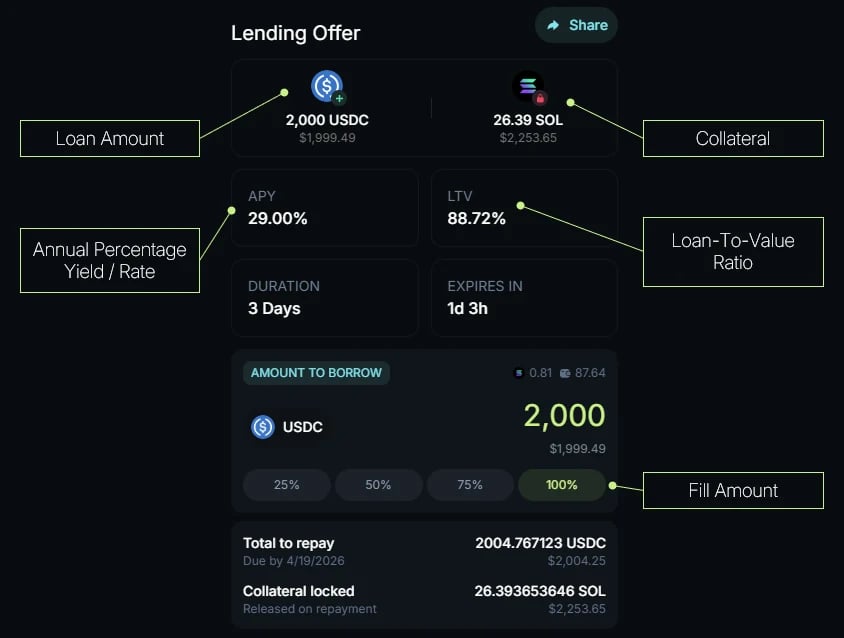
An annotated offer panel from an earlier version of Offerbook. The current panel shows the terms in a single row and sets the amount with a slider instead of percentage buttons. Amounts date from when the screenshot was taken.
3
Accept the offer and start the loan
Click Borrow and approve in your wallet. The loan starts immediately: your collateral is locked, you receive the USDC, and you pay the 25% upfront fee on the interest. You can add the maturity date to your calendar at this point.
For a quick ask, Create your own offer, among the offers in the Borrow card, opens a composer on the same card. For the full flow below, use Create Offer > Borrow in the header, which opens the Ask for a Loan page.The screenshots in these steps come from an earlier version of Offerbook: the flow is the same, but some fields have moved since.
1
Collateral
Choose your collateral asset and the amount that will be locked for the duration of the loan. Set the USDC amount you want to borrow (at least $10). The amount and the LTV, the ratio between the borrowed USDC and the value of your collateral, update together. Quick Pricing presets (Recommended, Match best, Beat market) position your LTV against competing offers.
2
Terms
Set your , which determines the interest due at maturity. It is displayed all-in: it already includes the 25% upfront fee, and the line below shows the split, for example “Lender keeps 16% · 4% protocol fee” on a 20% APR. Then set your loan duration, 1 to 30 days, which determines when your repayment is due. The flow shows what you will pay and a fill score comparing your offer with the market.
3
Publish
Choose Lock & list now to create the onchain offer: your collateral moves into escrow, and any lender can fill the offer instantly. Just advertise terms posts a free intent instead, with nothing locked. This step also sets Allow partial fills, with the smallest amount a lender can take in one fill, and, under Advanced options, the expiration: how long the offer stays open, 1 to 7 days. The expiration does not affect the loan duration.
Your offer is now live in the offerbook until its expiration. Once a lender accepts it, in full or partially, the loan starts immediately: you receive the USDC minus the 25% upfront fee on the interest, and your collateral is locked. Published offers cannot be edited, but you can cancel one at no fee before it is filled, and renew it from Dashboard > Offers once it has expired.
Monitor your loan’s maturity date from Dashboard, with the Borrowing side selected: the Positions tab lists your open loans. You can add a calendar reminder from the loan’s row, or rely on the Loan due soon notification if you have connected a channel in Settings.Repay at any time before maturity, with the action button on the right of the loan’s row, to reclaim your collateral in full. Remember: the full interest for the agreed duration is owed, even on early repayment.If the loan is extendable, its row leads with Extend instead, and Repay moves into the row menu. Extending pays the closing period’s interest and the origination fee for the new period, and starts a fresh period on the same terms, with your collateral still locked.If the maturity date has passed and the loan has not been fully paid off, the lender becomes eligible to manually claim the collateral, but you can still repay until the lender does so. Once the lender claims, the transfer is final.
Note: loan durations range from 1 to 30 days, set by the offer creator. The offer itself stays valid for a separate window of 1 to 7 days, also set by its creator.Marc holds $5,000 worth of tokenized stocks in his wallet. He doesn’t want to sell them just yet, as he wants to keep his exposure to them. But he needs about $1,000 in cash quickly to book a flight to Solana Breakpoint before prices go up. He knows he’ll be able to repay the loan within a month, once he receives his salary.
Step 1: Use assets as collateral to borrow with fixed terms
Instead of selling his assets, Marc plans to use them as on Offerbook to borrow USDC at fixed terms. He has two options:
Accept an existing lend offer (the fastest option)
Or create his own borrow offer with custom terms
He decides to create his own offer, as none of the existing ones meet his requirements:
Collateral: $2,000 worth of tokenized stocks, locked as collateral
Borrowed amount: 1,000 USDC to pay for his flight, an LTV of 50%
Duration: 30 days, as he expects to be paid within that time and repay the loan
APR: 20% all-in. Marc is willing to pay this rate, which represents about $16.44 for the month: about $13.15 of interest for the lender and a $3.29 upfront fee. He knows the flight will be more expensive next month, so he wants to secure a lender quickly.
He reviews and confirms all the parameters, locks and lists the offer, and it is now live on Offerbook.
A lender sees Marc’s offer and accepts it. A few things happen immediately:
The loan starts
Marc receives the 1,000 USDC minus the $3.29 upfront fee, about 996.71 USDC
His collateral is locked in a smart contract
He can now book his flight, for example by depositing the USDC into his Spend account in the Jupiter app and paying with his Jupiter Card, without selling any of his assets.
During the loan, Marc isn’t stressed about liquidation, even if the price of his collateral drops, because there is no price-based liquidation on Offerbook. He doesn’t need to monitor the position and simply waits until the repayment date, which he has set in his calendar.
After 30 days, Marc comes back to repay his loan: about 1,013.15 USDC, the 1,000 USDC principal plus about $13.15 of interest. The upfront fee was already paid when the loan started. He receives his collateral back in full.Meanwhile, the price of his flight to Solana Breakpoint has gone up by more than $100. His decision turned out to be the right one: the loan cost him about $16, he recovered his collateral, and he avoided the higher fare without selling his assets.
If Marc misses his repayment before the maturity date, the lender becomes eligible to claim the collateral. Marc can still repay his loan until the lender manually claims the collateral. However, once the claim happens, the transfer is final: Marc keeps the USDC he borrowed but loses his collateral.