


What is token burning?
When a token is burned, it is destroyed for good, which decreases the token’s supply. To understand the impact, three numbers matter:- Max supply: the maximum number of tokens that can ever exist under the token’s rules.
- Total supply: the number of tokens that currently exist onchain, meaning every token minted so far minus every token burned. It changes over time.
- Circulating supply: the portion of the total supply that is actively in the market, meaning the total supply minus tokens that are locked, still vesting, or held in a treasury.
How do you burn a token?
There are three main ways to take tokens off the market. Each works a little differently, and only the first one actually destroys tokens.- Direct burning: the token program’s burn instruction destroys the tokens and reduces the total supply. Projects call it directly or through dedicated tools. This is the mechanism formally known as a burn.
- Locking: projects can lock tokens with a tool like Jupiter Lock. Locked tokens are out of circulation for as long as the lock lasts, but every lock has an end, and some can be canceled depending on their permissions. A lock delays supply rather than removing it.
- Dead address: tokens can also be sent to a “dead address”, a wallet for which no one holds the private key. Those tokens are lost forever, but they still exist onchain, so depending on the data source they may still be counted in supply figures. Practically speaking, they are permanently off the market.
Jupiter’s burn mechanisms
Jupiter has several mechanisms that reduce the supply of JUP. Supply reduction: Jupiter carried out a community-approved reduction of the total JUP supply. The Supply Reduction Proposal explains it and its rationale. Litterbox Trust: since February 2025, 50% of Jupiter’s onchain revenue goes to the Litterbox Trust, a non-profit entity that buys JUP on the open market through automated, programmatic onchain purchases. The trust functions as a long-term strategic reserve, and it has burned approximately 134 million JUP to date. You can follow its wallet on Solscan.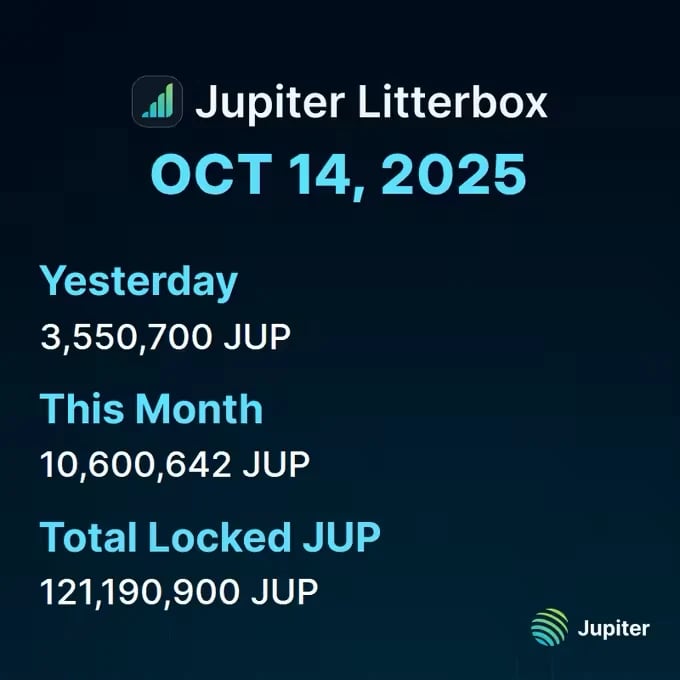
A Litterbox update dated October 14, 2025. The figures have changed since: the Litterbox Trust wallet on Solscan shows the current balance.
- Express Review, for creators who want a faster review of their token’s verification request. It guarantees a first review within 24-48 hours, with up to 2 further reviews if needed. Standard Review is free, so only Express requests burn JUP.
- Token metadata updates, for anyone who submits a change to a token’s name, symbol, logo or other details across Jupiter.
Why burns matter to holders
For holders, a burn permanently reduces the total supply. It doesn’t guarantee any impact on price, and unlocks and staking rewards can still add to the circulating supply. What a burn does offer is a commitment anyone can check: unlike a stock buyback disclosed in a quarterly filing, a burn is an onchain transaction, visible to anyone on the blockchain. To see how burns fit into the bigger picture, read JUP tokenomics and the Jupiter governance guide.Go deeper
JUP tokenomics
Allocation, team vesting on Jupiter Lock, and the supply reduction.
Transparency
Jupiter’s revenue split, the Litterbox Trust and value accrual.
Token verification
Standard and Express Review, criteria, and the 1,000 JUP Express fee.